“The Sounds of TVS” Podcast: What They’ll Remember
Graduating Learners Reflect on Growth, Community, and the Maze of Middle School
Produced by Caroline Powell
Transcript Below
Transcript
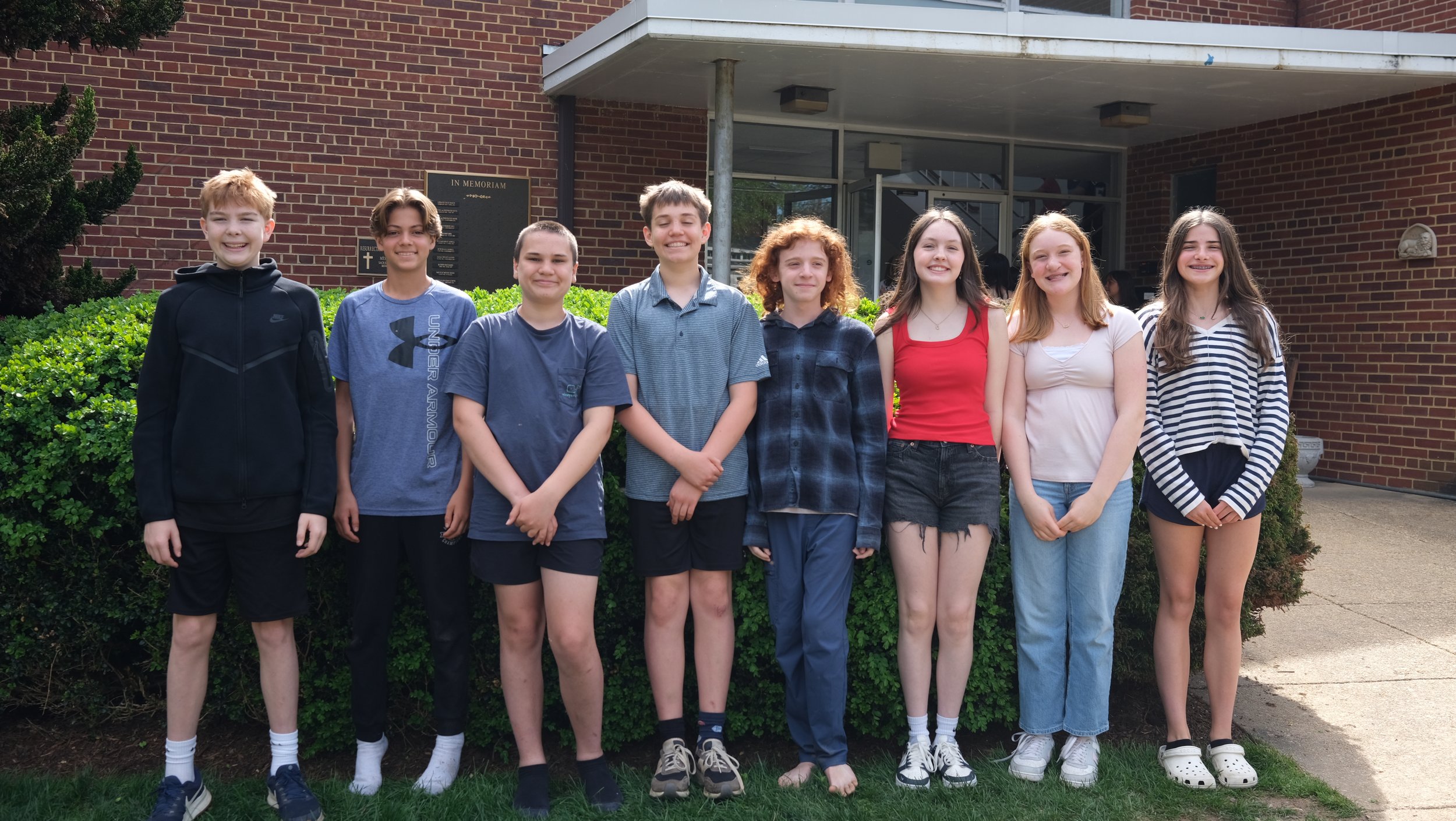
Welcome back to the Sounds of TVS, a podcast where you can hear stories of the Village School, directly from the voices of the learners. As the end of the school year quickly approaches, eight of our learners are preparing to graduate from the Village School.
Vivien, Wes, Colin, Ossian, Nora, Nate, Charlotte, John
Before they leave, I sat down with them to ask them one simple question: How would you describe your time at TVS? Over and over again, these were the words I heard them say:
Colin: Journey
Wes: Independence
Charlotte: Growth and belonging
John: Community
Nora: Definitely passion
Vivien: Happiness
Ossian: Collaboration and perseverance
And as Nate described it -
Nate: It’s kind of like a maze
When I asked about some of their favorite memories, it became clear that what stood out weren’t just big milestones or events - but the small everyday moments they shared with each other.
Charlotte: My favorite memories from TVS are just like the ones where we’re all just kind of hanging out together.
Nora: When we're just like, in the studio, hanging out as a full studio, that I feel like are some of my favorite memories, or when we're just kind of chilling.
And those moments extended outside - to the park.
Wes: Well, for me, it's probably just being with my friends, especially at the park. We have a lot of freedom at the park and we use it to do a lot of stuff. Build shelters, and we've also raced little pieces of wood down the creek. It's really been a great experience- the park, for me. So many things have happened there, and it's been so memorable because I haven't had an experience like that in any of my previous schools. So it's been really great.
Nate: My favorite memory at TVs was in like seventh grade, when we all went to the park and we went to like the waterfall and we slid down the rocks at the waterfall. It was fun.
Ossian: My favorite memory from TVS was really a collection of memories when me and a couple other people were really dedicated, and we dug a good three foot hole into the side of a bank at the creek, and we built a fort around it, and it was really cool to see what we could accomplish with that much teamwork.
Colin: We build shelters and we'll run around and play like games, and then we also have Health and Wellness there. So, the park is just overall a good experience.
And beyond the day to day, there were shared experiences that brought them closer together - like the annual Adventure camping trip. Even when the weather was less than ideal, what stood out the most was the sense of community they built together.
Nora: When it's kind of like rainy on the camping trip and we're all we were all just like sitting in the tent. We were kind of just like hanging out, and it was just like fun, I don't k now, just like, being there
Vivien: I will always remember the annual camping trip that we take in Adventure studio, which is the middle school studio. It's always really fun. And even though it rains every time, it's like a really good like, community bonding experience,
That sense of connection shaped not only their memories, but also how they grew as learners. Because while they spoke about academics - projects and badgework, it was clear that what they gained went far beyond that. In many ways, they weren’t just learning content. They were learning about themselves.
Nora: I found that I have passions for things that I never realized… and how much I enjoy learning.
John: I've learned a lot … like, my whole mindset towards learning has shifted a lot. Growth mindset, learning how to overcome challenges, that has really been helpful. About me - something I learned is I really like, like, debating people and thinking on my feet, things like that.
Nate: Something I've learned about myself is that I'm a good learner, and I'm capable of learning about anything, if I really dedicate my time to it.
Wes: Well, I've learned that I'm actually kind of smart. I didn't really think of myself as such at my previous school, but I think I've since learned that obviously I'm not the best at everything. But I've learned that I actually have a fair bit of intellect about a lot of different topics, especially I'm really strong with history. But through this school, I've also been able to increase my confidence in other stuff like math and reading that I didn't really think of myself as very good at previously.
Colin: I've learned that about myself … that I can do a lot of things.
Charlotte: I think I learned the importance of a community, and not only having people show love and support for you, but really showing up for other people. I think more than just, thank you guys for supporting me - I am really, always trying to support others in my community. I think that's been really important that I just don't know if I would have learned anywhere else quite as well.
They discovered passions they didn’t know they had. They began to see themselves differently - more capable, more confident, more willing to take risks, and what it means to show up for others. But that growth didn’t come easily - there were challenges, setbacks, and moments of frustration.
Nora: I feel like I didn't do as much work in sixth grade, and that kind of made it harder later on.
Charlotte: Because the same thing kind of happened to me in sixth grade, and I think and even in seventh grade, because I was like, ‘Oh my gosh, I have so much time here - three years until I graduate,’ and it snuck up on me so fast. I can't believe I'm graduating in just a couple months because I feel that I've caught up pretty well, but it's taken so much work to get where I am now.
Vivien: I will never forget the conflicts that I've had, and how we always have to solve them on our own. And I actually like that, because I think it's fair, and I don't think it's one-sided and I really like how we are able to do that.
John: I agree. Definitely solving our own problems, like in community meeting, that's been quite an ordeal, but a fun one.
They talked about procrastination, about falling behind, about conflict and hard conversations. But instead of avoiding these moments, I was really struck by how learners spoke about their own resilience. Because at TVS, failure isn’t the end of the story - it’s part of the process to help us grow!
Charlotte: Something I've learned about myself is that I can take on hard things, even if they are really challenging, and I am kind of panicking. Now, I trust myself more than I ever have, and I believe in my capabilities and what I've learned and that I can, even if I don't get it perfect, I can still try and get it done, which I don't think I would have said before coming here.
Nora: I think embracing failure and learning from failure, too. l previously would have just gotten really upset if I failed. But now I can, kind of think, ‘Well that didn't work. What can I try now?’ mindset. I think that that's been really important.
Ossian: I've heard a quote, it's like, ‘if you trip and fall you can always get back up.’ There's no time in TVs when you can't. Just never forget, even if it feels like you can't get back up, always try and always ask for help.
Wes: I have certainly experienced not everything going according to plan. I mean, it happens very often, especially when you're setting your own goals, because things can certainly happen that you did not anticipate, and it can throw you off. It's happened to me a lot. But the very, very important thing to do is to not stop and to keep going.
Charlotte: Self motivation and relying on myself and motivating myself instead of waiting to be motivated by something else.
Nora: Independence and learning to kind of rely on myself and to be independent, because I won't always have someone there, telling me what to do … and to learn to be able to manage myself - that has been something I've really grown in.
Charlotte: There was like a quote. I don't remember exactly what it was, but it was like, use your failure to power your motive, like motivate you. And I really like that quote, because I think that also is kind of what TVs helps us embrace, is when you fail at, let's say a Kahn problem. I always just feel more motivated to then do it again and get it right to Yeah, kind of almost prove to myself that I can do it.
And again and again, they turned to the same idea. They learned how to navigate these challenges and not give up. You adjust, try again, and keep going. And that’s where Nate’s idea of the maze comes in.
Nate: I call it a three year maze. Because for me, my TVS experience is kind of like a maze. There's many different paths you can go down. You’ve got to find the right path, and sometimes there's multiple paths. A maze. There's multiple good ways you can go, sometimes you'll get lost, sometimes you get stuck, but you don't stop. You gotta go in other ways. You gotta find your way out. And so far, we're almost at the end. We only got, like, two more months, so yeah,
There's been a lot of ways you can get out of the maze. You gotta find the right way. If I'm on Khan and I'm messing up on a course challenge. I was on the course challenge last year and I messed up on the second to last question, but I didn't stop. I mean, I got a little mad. You got to keep going. The challenge isn't going to solve itself. You gotta keep going.
Ossian: I really agree with what Nate said,and how he phrased it as a maze. And that's the thing about TVS. Every learner has their own maze that they have to get through, and each learner has a different maze. And at TVS and the guides really adapt to everybody's mazes and help them get through it and help them conquer every path and learn new things on the way.
Each learner has their own maze. Their own path. Their own challenges to work through. And along the way, they don’t just find answers—they find themselves. So what would they say to learners just beginning that journey in Adventure?
Charlotte: I would probably say just enjoy every day.
Vivien: My advice would be to always ask for help.
Ossian: One piece of advice I would give to anybody going into adventure is find who you want to be.
John: Befriending someone when it seems daunting. I was kind of intimidated talking to the guides on my first day in adventure, but then it just sort of got easier, and you learn how to just make conversation. And I think that's been helpful.
Nate: Don't be scared to talk to other people. I mean, they won't bite! I mean, we got a lot of nice people in our studio, a lot of nice people in our school. We got guides that are welcoming and you could ask any question, then they'll help you. You can make plans. You can customize your learning experience at TVs. So I feel like, yeah, don't be afraid to talk to others.
And now, as they prepare to leave. I asked them. What do you take with you?
Nate: There's a lot of valuable things I've learned about friendships and stuff like that I'll have to take into high school in college, and my the rest of my life,
Ossian: The model at TVS, and its openness has really showed me how not to be afraid of the world. You could say I was never scared of going outside, but it kind of adapted me to see the world how it is and see problems that are in the world, not only what's going good and what's going bad, just solutions. It's given me an inventive … like a problem solving mindset for everything in the world.
Colin: I think a lot of the things I'll remember is that I didn't like school before I came here, but now I like it. And my friends are also people that I'm probably not gonna forget.
Charlotte: I think in five years, I'll probably look back and just be so grateful for all the lessons I learned. We do so much collaboration here, and we have so many opportunities to work on our leadership skills, and I think that will definitely serve me,
Friendships, confidence, and a belief in themselves. Because in the end, what the learners will remember won’t just be the fun memories at the park, the launches, the projects, or field trips. It will be who they became.
So, as they reach the end of the maze they will leave knowing something that they didn’t know before. They can figure it out. They can take on hard things. And wherever they go next - they know how to keep going.